
If you’ve ever struggled to explain what your brand stands for (without resorting to buzzwords or “jazz-hands”), the Storaitelling Brand Canvas Course was built for you. It’s a free, bite-sized program—5 minutes a day for 5 days—that helps you turn scattered ideas into a clear, compelling brand narrative you can use everywhere: websites, pitch decks, fundraising, hiring, demand gen and beyond.
Below is a tour of the key principles you’ll master—and why they make a difference.
1) Start with your “why”: the Purpose Pyramid
Your brand isn’t a logo; it’s a set of codes that trigger specific impressions in your audience. Those codes snap into place when you align your purpose, mission, vision, values, and lexicon—what we call the classic brand hierarchy (aka the Purpose Pyramid).
- Purpose: why you exist.
- Mission: what you’re going to do about it.
- Vision: the world you’re working to create.
- Values: how you behave while you get there.
- Lexicon: the signature words and phrases you repeat to build memory.
This hierarchy becomes your organization’s north star for decisions, hiring, product choices, and storytelling.
2) Turn ambition into clarity: Mission, Vision & Lexicon
Once you’ve defined your purpose, you’ll shape mission (your “what”) and vision (your “where it leads”). You’ll also begin a simple lexicon—the words you intentionally use (and don’t use) to reinforce tone and positioning.
- In D2C, see how Too Good To Go sets a crisp mission (“inspire and empower everyone to fight food waste together”) and a vision of a world where food produced is food consumed—language that rallies consumers and partners alike. You’ll learn why this coherence works and how to emulate it without empty clichés.
- In B2B, look at LinkedIn: a plain-spoken mission (“connect the world’s professionals…”) paired with a far-reaching vision (“create economic opportunity for every member of the global workforce”). It’s specific, scalable, and easy to remember—exactly what your stakeholders need.
You’ll practice drafting both statements and curating your brand’s vocabulary so your narrative sounds consistently you across every channel.
3) Map the story: The Brand Canvas
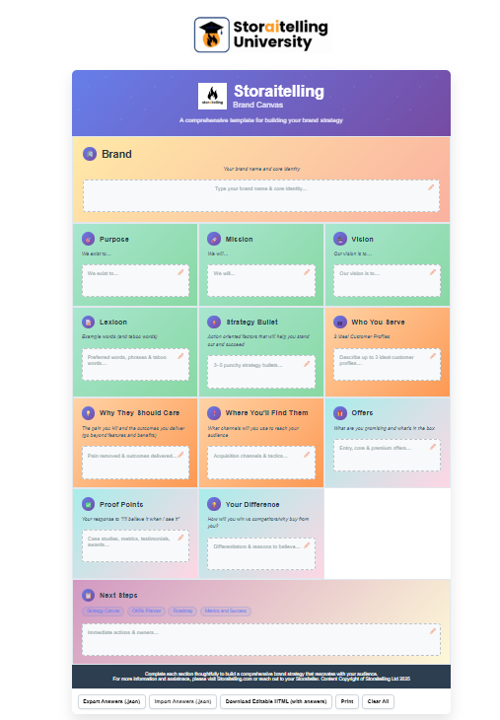
Think of the Brand Canvas as your storytelling blueprint—a one-page guide that captures the hierarchy above and then layers on strategy and market context. You’ll download the template and fill it in as you go, so by the end you’ve got a working, shareable artifact.
- In B2B, we explore Shopify to show how purpose/mission/vision guide a platform strategy (ecosystem, scale, multi-channel). You’ll see how big statements translate into concrete choices.
- In D2C, we return to Too Good To Go to show a “win-win” value prop that delivers for multiple stakeholders—consumers, businesses, and the planet—while staying true to purpose.
4) Make it resonate: Customers, Channels & Story Arcs
No story works without an audience. You’ll define your Ideal Customer Profile (ICP), the channels where they already spend time, and the story arcs that link your brand to problems they feel and outcomes they want.
Here we go deeper than features and benefits:
- Benefits = what your product does (e.g., saves time).
- Outcomes = what that enables (serve more customers, spend time on what they love).
You’ll practice writing arcs that connect outcomes to emotion (yes, even in B2B—decision-makers are people first).
5) Prove it and differentiate: Offers, Proof & the “So What?”
The final layer grounds your narrative in action: what you sell, why people should believe you, and why they’ll choose you.
- B2B example — TeamSupport: a support platform built for complex B2B relationships, not one-off tickets. Proof? Case-study metrics and a Customer Distress Index® that helps teams intervene before churn.
- D2C example — Native: clean-ingredient personal care with early, well-executed subscriptions. Proof via ingredient transparency and thousands of reviews; differentiation via a tight mission + recurring-revenue model.
You’ll capture your own offer, proof points, and differentiators—with a reminder that buyers purchase outcomes, not just products.
What you’ll walk away with
By the end of the 5 bite-size sessions you’ll have:
- A complete, investor-ready Brand Canvas on one page.
- A clear go-to-market story that aligns your team and accelerates execution.
- Sharpened ICPs, channels, and story arcs that make your marketing land where it counts.
- A repeatable lexicon and hierarchy to keep every deck, web page, and sales conversation on-brand.
And yes—it’s genuinely 5 minutes a day for 5 days. No fluff. No dawdling. Just focused exercises that get your thinking out of your head and into a practical framework you can use immediately.
Who it’s for
- Start-ups & scale-ups that need a credible, consistent story for customers and investors.
- Change-ups inside established orgs that need a refreshed narrative for new bets.
- Grown-ups who want to align teams and reduce wasted cycles across brand, product, and sales.
Ready to build a brand people feel?
Join the free Storaitelling Brand Canvas Course today. In less than a week you’ll have a working brand canvas, confidence in your story, and a practical way to guide decisions—from your next campaign to your next funding round. (Oh, and it’s free. Did we mention it’s free?)
Enroll now and let’s get your story working as hard as you do.
Comments are closed